
Learn how to tell data science stories that drive executive decisions. Transform analytics outputs into compelling narratives that influence business outcomes and strategic direction.
Data science produces insights. Data science stories produce decisions. The difference matters.
Most organisations struggle to translate analytical outputs into narratives that executives understand and act on. Models run. Dashboards populate. Reports generate. Yet decisions stall. The problem is not the data science. It’s the storytelling.
Here’s how to tell data science stories that influence strategic outcomes. If you’re facing challenges turning analytics into action, our advisory services help executives connect data insights to business decisions.
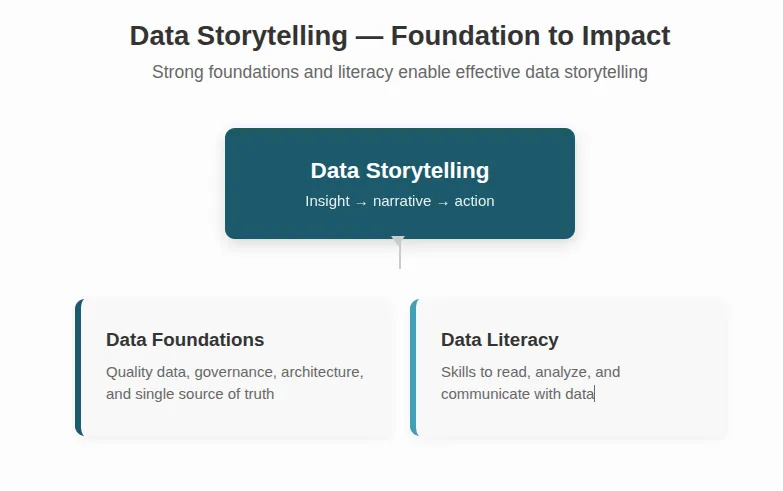
Effective data storytelling does not begin with the slide deck. It begins with data foundations and data literacy.
Data foundations — governance, quality, lineage, and clear ownership — determine whether the data you are telling stories about is trustworthy. Without them, the most compelling narrative is built on sand. Data literacy — the ability to read, interpret, and question data across the organisation — determines whether your audience can engage with the story at all. Executives who lack data literacy default to intuition when the story feels opaque.
Investing in data foundations and data literacy is what makes data storytelling possible. The story is the final layer. The foundations come first.
When crafting a data science story that drives decisions, these elements matter:
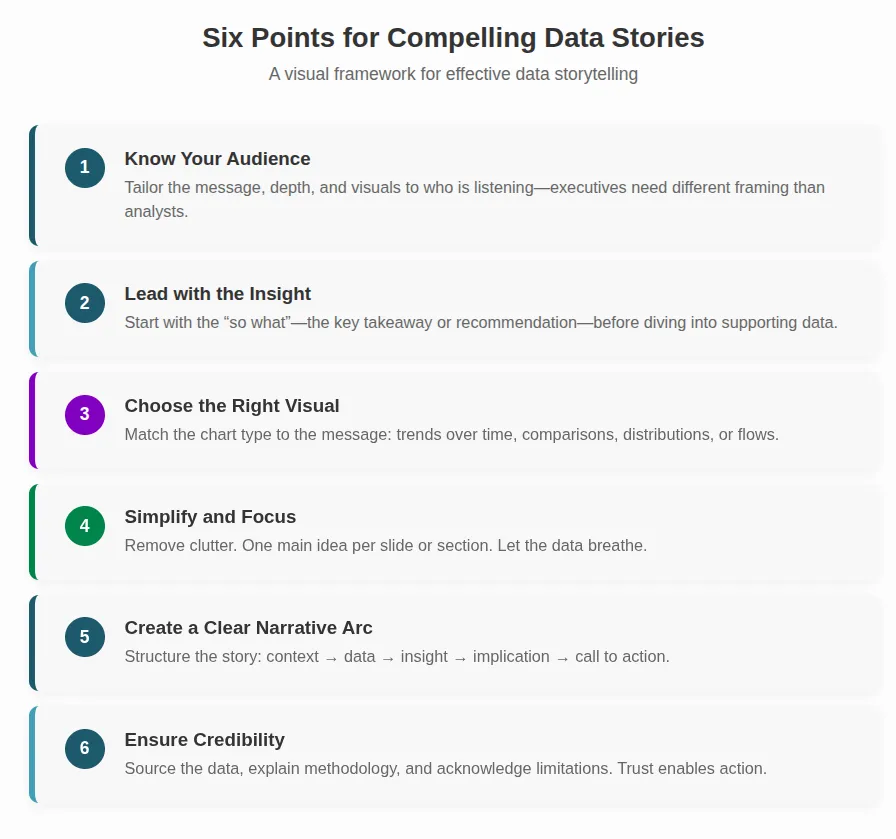
Defining the “so what” — Every insight must answer: why does this matter? What changes because we know this? If you cannot articulate the “so what” in one sentence, the story is not ready. Executives will ask it anyway. Answer it first.
Understanding your audience — Technical teams care about methodology. Finance cares about cost and risk. Operations cares about throughput. Sales cares about pipeline. The same data supports different stories for different audiences. Tailor the narrative, the framing, and the level of detail to who is in the room.
Building a data-driven narrative — A narrative is not a list of facts. It has a beginning (the business question), a middle (what the data reveals), and an end (what should happen next). Structure the story so each element builds on the last. The data drives the narrative; the narrative drives the decision.
Visual storytelling: use the right charts — Not every chart fits every message. Use bar charts for comparisons. Line charts for trends. Scatter plots for relationships. Avoid clutter. Highlight what matters. The right visual makes the pattern obvious; the wrong one obscures it.
Communicating uncertainty and assumptions — Every model has limits. Every dataset has gaps. Acknowledging uncertainty builds trust; hiding it destroys it. State assumptions explicitly. Show confidence intervals where relevant. Explain where the analysis holds and where it does not.
Driving action through stories — The story succeeds only when it leads to a decision. End with clear next steps: what should happen, who owns it, and by when. Stories without a call to action are reports, not narratives.
Technical accuracy does not guarantee executive engagement. You can have statistically significant results and still fail to influence decisions. Data science stories bridge the gap between analytical rigor and strategic action.
The Executive Context Problem
Executives operate under constraints data scientists rarely consider. Time pressure. Competing priorities. Risk aversion. Political complexity. A well-told data science story accounts for these constraints. It presents insights executives can act on within their reality—not just within the data’s reality.
The Trust Problem
Executives distrust outputs they don’t understand. When data science feels like a black box, decisions default to intuition. Good storytelling makes methodology transparent without overwhelming non-technical audiences. It builds trust by showing why the insight is credible, not just what the insight is.
The Action Problem
Most analytics outputs answer questions nobody asked. They provide information without context. Data science stories start with the business question, show what the data reveals, and clarify what should happen next. They create a path from insight to action. Learn how our evaluation framework connects data insights to practical business decisions.
Compelling data science stories share common elements. They’re not about dumbing down analysis. They’re about structuring insight for strategic consumption.
Start with the Decision
Strong data science stories begin with the decision at stake. Not the data. Not the methodology. The decision. What choice must executives make? What trade-offs exist? What risks need managing? Frame the story around this decision point, then introduce data as evidence.
Example: Instead of “Our churn model shows a 12% accuracy improvement,” try “We can now identify at-risk customers three months earlier, giving sales time to intervene before contracts expire.”
Make the Invisible Visible
Data science reveals patterns humans can’t see in raw data. Good storytelling makes these patterns concrete. Use comparisons, analogies, and reference points executives recognize. Translate statistical significance into business impact.
Example: Instead of “The correlation coefficient is 0.87,” try “For every 10% increase in delivery delays, customer satisfaction drops by 8.5%—enough to shift Net Promoter Score from industry-leading to average.”
Show, Don’t Just Tell
Visualization matters. But not every visualization tells a story. Executives don’t need every data point. They need the pattern that drives the decision. Simplify charts. Remove clutter. Highlight what matters. For executives evaluating executive data framework, clarity beats comprehensiveness.
Structure provides clarity. These elements appear in most compelling data science stories:
1. Context: The Business Question
Start with why this matters. What prompted the analysis? What decision hangs in the balance? What happens if the organisation gets this wrong? Context creates urgency.
2. Insight: What the Data Shows
Present the core finding. Not all findings—the core finding. The pattern that changes how executives should think about the problem. Support it with evidence, but don’t bury the insight in methodology.
3. Interpretation: What It Means
Bridge from statistical output to business implication. What does this finding mean for revenue? For risk? For competitive position? For operational efficiency? Executives need interpretation, not just information.
4. Action: What Should Happen Next
Conclude with clear next steps. What decision should executives make? What resources are required? What risks exist? What timeline makes sense? Data science stories that end without recommended actions waste executive time. See how our advisory approach translates data insights into actionable recommendations.
Even strong analytical work fails when storytelling falls short. These patterns undermine otherwise solid insights:
Leading with Methodology
Executives care about methodology only when it affects trust. Starting with technical details loses attention before the insight emerges. Methodology belongs in appendices or follow-up discussions, not in opening slides.
Drowning in Detail
Every analysis generates dozens of findings. Not all matter equally. Weak data science stories present everything. Strong stories curate ruthlessly. Show what drives the decision. Reference the rest as “available upon request.”
Ignoring Uncertainty
Every model has limits. Every dataset has gaps. Pretending otherwise erodes trust. Strong data science stories acknowledge uncertainty explicitly. They show confidence intervals. They clarify assumptions. They explain where the model works and where it doesn’t.
Forgetting the Audience
Technical teams understand statistical significance. Executives understand business impact. Finance understands cost. Operations understands throughput. Sales understands pipeline. Tailor the story to the audience. Same data, different framing. For finance leaders evaluating accounting automation decisions, focus on audit risk and control implications, not just efficiency gains.
Practical steps for improving how you tell data science stories:
Test the Story Before Presenting It
Run the story past someone outside the analytics team. Can they explain the core insight back to you? Can they articulate the recommended action? If not, simplify.
Start with the Punchline
Executive time is scarce. Lead with the core finding and recommended action. Those interested in supporting evidence will ask. Those who don’t won’t sit through 15 slides to find the point.
Use Natural Language
Avoid jargon. Write as you would speak. If you wouldn’t say “multivariate regression” in a hallway conversation, don’t use it in the story. Say “we analyzed how five factors influence customer retention” instead.
Connect to Strategy
The strongest data science stories connect insights to strategic priorities executives already care about. Revenue growth. Cost reduction. Risk mitigation. Customer experience. Competitive positioning. Frame the insight within these priorities. Our enterprise data advisory help leadership teams connect data insights to broader strategic objectives.
Sometimes stories fail despite strong execution. The problem is not storytelling. It’s timing, politics, or priorities.
Wrong Decision Window
Insights delivered after decisions are made waste time. Align analytical timelines with decision cycles. Know when budget approvals happen. When strategic planning occurs. When performance reviews take place.
Conflicting Agendas
Data science stories challenge assumptions. When assumptions are politically valuable, resistance emerges. Acknowledge this reality. Focus on risk framing rather than blame framing. Show what could go wrong if the insight is ignored, not who got it wrong previously.
Unclear Authority
Executives won’t act on insights when accountability is unclear. Make sure the person receiving the story has authority to make the decision. If not, adjust the audience or escalate appropriately.
Data science creates value only when it influences decisions. Insights trapped in notebooks, models, or dashboards deliver nothing. To tell data science stories effectively, start with the decision, make patterns visible, structure insights clearly, and conclude with actionable recommendations.
If your organisation struggles to translate analytics into executive action, start a conversation about how independent advisory helps connect data insights to strategic decisions. Or explore how we evaluate data and governance investments with clear communication built into every phase.
Further Reading: