
Self-service analytics, self-service BI, and self-service reporting for leadership. What to decide before choosing tools—definitions, ownership, certification—and how to evaluate analytics and BI platforms without a vendor list.
Self-service data analytics and self-service business intelligence usually describe the same goal: business users answering questions without queuing every request through a central team. BI emphasises governed metrics and dashboards; analytics adds more exploration and ad hoc cuts. Labels matter less than whether definitions are owned and numbers reconcile—otherwise self-service scales rework, not insight.
This page does not recommend vendors. It frames decisions that should precede self-service reporting expansion and self-service analytics tools / self-service BI tools investment. Master data governance and enterprise data strategy sit upstream of any tool choice.
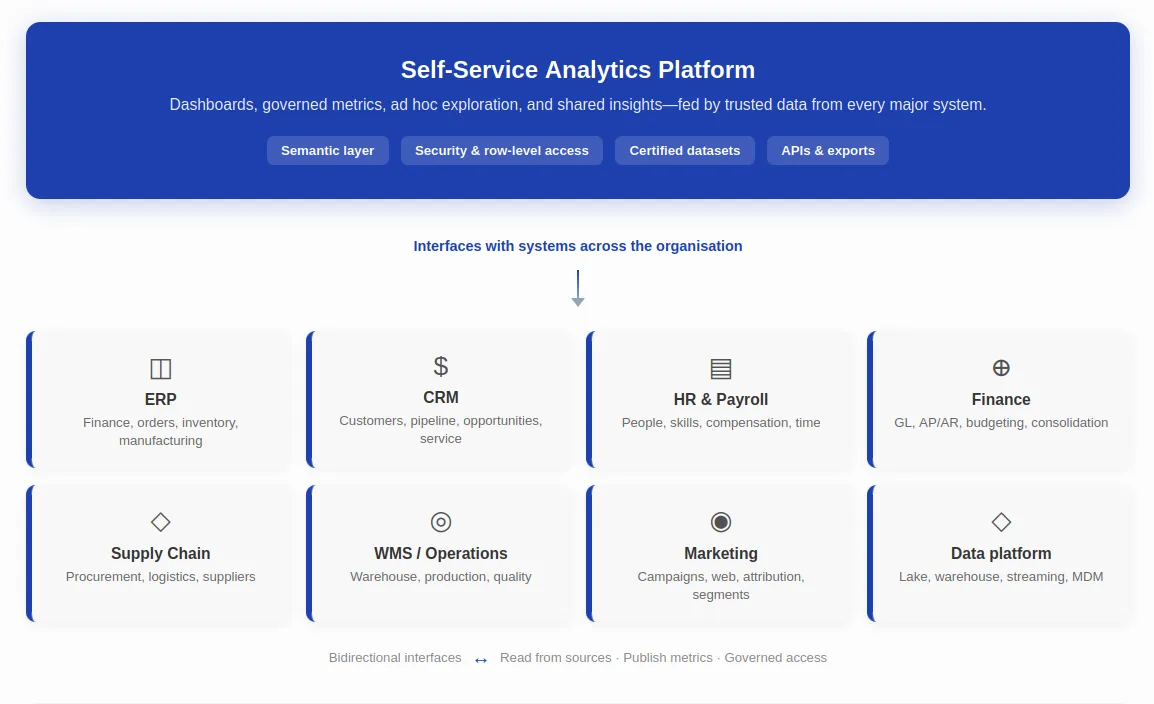
Self-service reporting — scheduled cuts, standard operational views, refreshed dashboards — is how most users start. It still needs an owner for each canonical metric, a path to certify figures against finance or source systems, and a rule for what happens when two reports disagree. Without that, reporting volume goes up; trust does not.
Assess self-service analytics tools on governance fit, not feature demos alone:
Capability without ownership rarely holds; AI readiness is often overstated when foundations are missing.
Most organisations do not self-serve directly against a single modern warehouse. Legacy ERP, mainframes, and older operational systems still hold authoritative transactions; integration is usually batch extracts, replication, or middleware—not real-time joins on demand. For self-service, the governance question is which of those paths may feed certified reporting and the semantic layer, and which stay off-limits because they would encourage ungoverned copies or inconsistent refresh. Tool connectors alone do not fix this; integration choices belong in data architecture and ownership of staging areas, not in individual analysts’ exports.
Self-service BI tools usually depend on a semantic model: dimensions, measures, and logic defined once. Check that KPIs mean the same thing everywhere, certified vs exploratory content is distinguishable, and access matches HR/IT roles. Otherwise each function builds its own report universe—none of which ties back at quarter-end.